
Desirability Feasibility and Viability
- Cascade
- Apr 6, 2022
- 2 min read

We have all seen the UX, Business and Tech Venn diagram, if you haven't, here you go:

It is a popular Venn diagram, attributed to Martin Eriksson who defines product management as “the intersection between business, technology and user experience”. He continues to say, "A good product manager must be experienced in at least one, passionate about all three, and conversant with practitioners in all." I totally agree with Martin and this simplification is helping me in my transition to Product Management.
A strong command of these three makes a good product manager, but the big question is, "is the intersection of ux, tech and business enough to make a great product?"
I think it is, but it is not focused enough in a world where there are usually a million and one other options for your users and(or) customers. I present another Venn diagram you should be familiar with:
Say hello to the Three Drivers of Innovation

Desirability - is this the RIGHT Solution for the RIGHT Problem?
Identifying the right problem is usually not the problem most times, solving it with a usable, enjoyable and equitable solution is THE problem. Like my people will say, Ọ̀nà kan ò wọjà (there are several routes to the market), there are always going to be different ways to solve a single problem but more often than not, the company that finds the RIGHT solution gets the love and admiration of users/ customers. I think one mistake PMs and founders make many times is they get too excited about a product/ feature and forget to place initial focus on the desirability to the users/ customers.
If we don't have desirability then feasibility and viability will not matter.
Feasibility - Do we have the Capacity to Build this Solution under Limited Resources?
Time, money and other resources are limited, at every point in time, there is a need to prioritize and develop products/ features that are within reach.
The following are some feasibility factors:
Technical limitations
Budgetary constraints
The impact of a product on branding, marketing, customer support, and other functional areas of the business.
Time-to-market estimate
Operational capabilities
Ideally, you want to design a new product or feature within the company’s current capabilities and make use of available resources. If a solution necessitates building completely new capabilities, you increase the risks and costs. With more success, we can always iterate on what we have and release new features and updates.
Viability - What is the ROI and Payback Period?
This is the ultimate test for your product/ feature. It focuses on your solution's value chain to ensure that it is viable now and in the long run.
The ROI is a method for estimating the efficiency of an investment (like deciding to build a new product or feature). Calculating ROI for various problems will help you understand where to direct your team's efforts and company's resources to have the greatest impact.
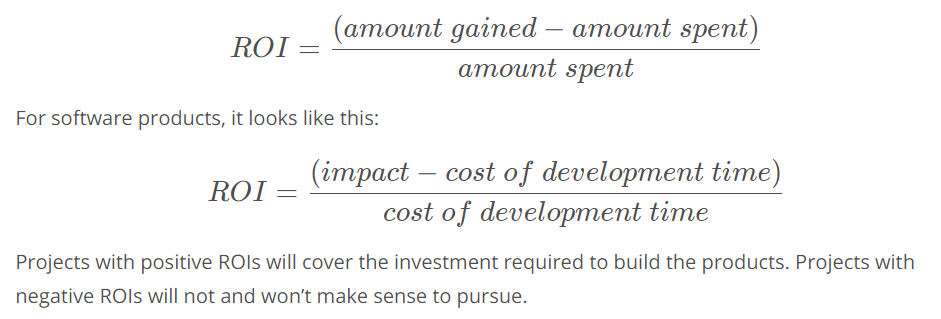
The payback period of a product is how long it will take to earn back the upfront cost required to build it.

Viability takes into account not only profit but also sustainability to ensure that your business continues to solve users/customers' problem and meet business needs.


Brief and insightful.
This was a great read. Keep it up!🙌🏻
Easy to understand and straight to the point. Good job
We are here nurse ofela of canada
Interesting and educative